Beauty & care
Best Fragrance Ingredient Scanner Apps in 2026
Compare fragrance ingredient scanner apps in 2026. See Toxic Scan and alternatives for reading cosmetic labels, checking product versions, and spotting gaps.

A fragrance ingredient scanner is most useful when it helps you find and understand the wording on a cosmetic label. It becomes less useful when it turns an incomplete ingredient list into an assurance that the product will work for everyone.
Our editorial first pick is Toxic Scan for label explanations. ToxScan provides another general scanning option. INCI Beauty and Yuka offer alternative cosmetic-assessment workflows. All need to be used with the same basic rule: a scan cannot disclose information that the package does not supply.
Disclosure: Toxic Scan publishes this guide and places its own app first for label reading. Public feature descriptions were checked October 20, 2026. We did not perform independent accuracy or allergy testing. Inclusion does not mean an app offers a verified fragrance-allergy detection mode.
The Best Fragrance Ingredient Scanner Apps Compared
Scroll sideways to compare all columns.
| Pick | App | Main reason to consider it | Limit |
|---|---|---|---|
| 1 | Toxic Scan | Read explanations of cosmetic ingredients | Cannot identify an undisclosed fragrance formula |
| 2 | ToxScan | Compare a different general scanning workflow | General analysis is not an allergy assessment |
| 3 | INCI Beauty | Inspect cosmetic product compositions | Check the current package and exact product version |
| 4 | Yuka | Review a cosmetic product assessment | A broad score does not answer every sensitivity question |
1. Toxic Scan: Our Pick for Reading the Label More Closely
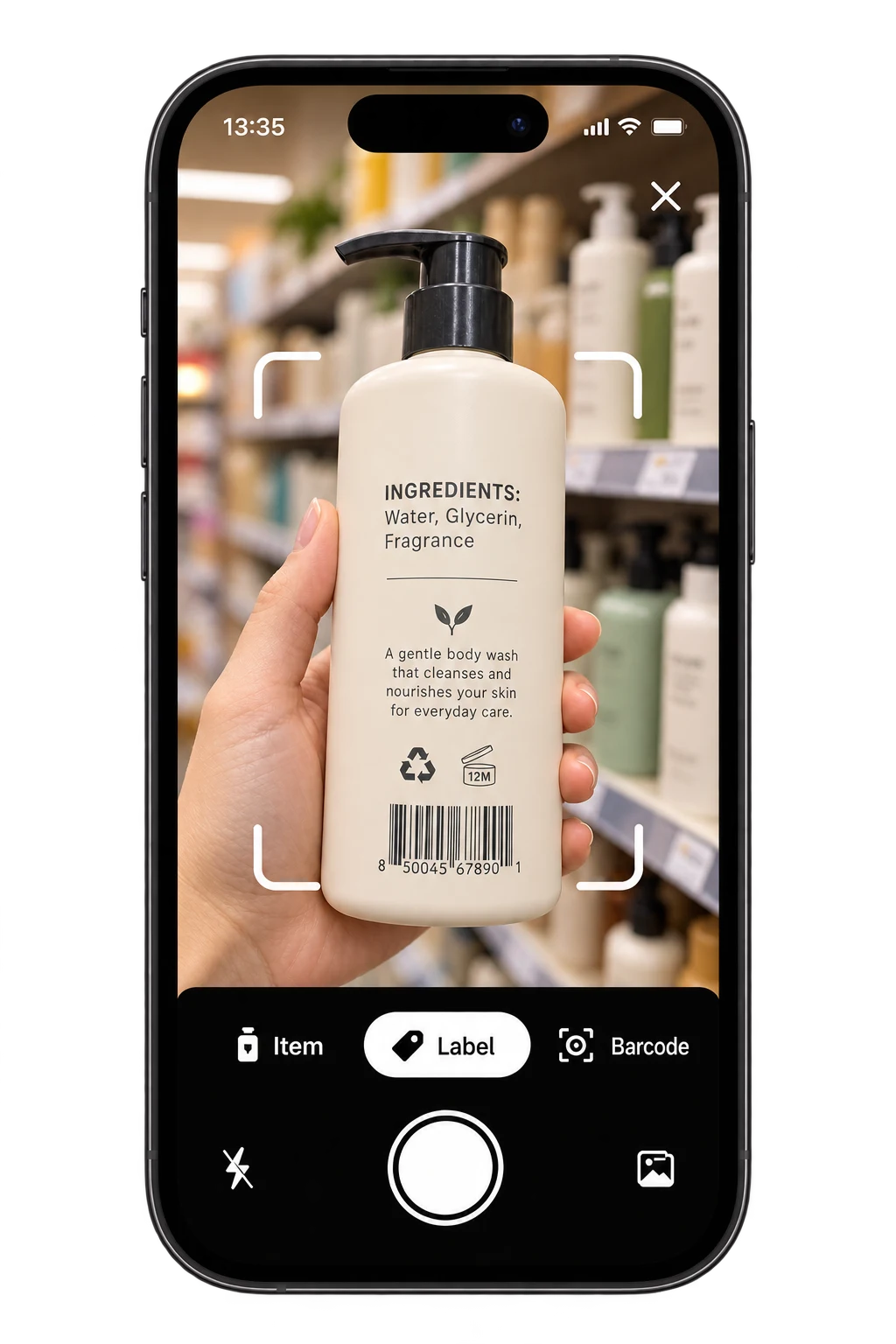
Toxic Scan explains ingredients from cosmetic labels. We recommend it as a starting point when you want to understand the words printed on a body wash, lotion, or other personal-care product.
Photograph the complete panel and check the transcription before reading the explanation. Focus on the exact term relevant to your concern. If the label gives only a collective fragrance term, keep that limitation in your decision rather than assuming the app knows the full blend.
Choose it for: General ingredient learning. Check first: That the explanation reflects the label and does not get mistaken for individual allergy advice. See the cosmetic ingredient checker.
2. ToxScan: A Second General Scanner to Consider
ToxScan describes coverage of beauty products in its App Store listing. It is another app to compare if you prefer a different format for reviewing ingredient information.
Use it on the same package as your first app. Make sure you are comparing the fragranced or fragrance-free version you actually own. Two similar bottles can lead to different records, and a result for the wrong formula cannot answer your question.
Choose it for: Comparing a general scanner's presentation. Check first: Product matching and the reason for each warning. Review the ToxScan listing.
3. INCI Beauty: A Cosmetics-Focused Composition Resource
INCI Beauty describes cosmetic scanning and composition information. It is a useful alternative to investigate when your main interest is your personal-care routine.
Check the composition before the rating. If you are looking for a particular ingredient, the useful result is whether the exact current formula lists it and what information remains unknown. A favorable rating cannot substitute for that check.
Choose it for: A cosmetics-focused approach. Check first: Whether the record matches your country, product version, and package. View INCI Beauty's feature description.
4. Yuka: A Broader Cosmetic-Assessment Option
Yuka includes cosmetic assessments in its product-scanning service. It offers another format for shoppers who want an overview before opening ingredient details.
Use the overview as a starting point. If your question concerns a known sensitivity, inspect the relevant wording and supporting information directly. An overall assessment may combine considerations that are different from the specific ingredient you need to check.
Choose it for: Comparing another cosmetic-assessment format. Check first: Whether its detail view answers your actual fragrance question. See Yuka's official page.
Why a Fragrance Scan Has Limits
In the United States, cosmetic fragrance mixtures can be listed collectively as fragrance. The FDA explains this labeling approach, along with fragrance allergies and sensitivities. A camera cannot reconstruct a full undisclosed mixture from a collective label term.
The practical result is simple: an absence of a particular name on the panel may leave a question unresolved. It does not always establish that the component is absent from the fragrance blend. If that detail matters to your care plan, seek product-specific clarification.
This is also why a scanner should not promise that one ingredient list will predict everyone's response. Use it to organize and interpret available information, then follow your clinician's advice for diagnosed allergies or persistent symptoms.
Compare the Right Product Versions
Choose two products from your shelf before downloading several apps. Note the full names, whether they are rinse-off or leave-on products, and whether you own a scented or unscented variant. Photograph the ingredient panels so the comparison stays tied to the packages.
Then inspect each app's match. Does it display the same version? Does the listed composition agree with your bottle? If not, resolve that mismatch before considering any favorable or unfavorable assessment.
Do not treat multiple apps agreeing on the wrong record as confirmation. They may be describing a formula that is different from yours. The exact product match is more useful than a majority vote.
Build a Simple Fragrance-Checking Workflow
- Start with the exact ingredient names relevant to your needs.
- Read the current package before scanning.
- Scan the complete panel in clear light.
- Compare the result with the package wording.
- Identify unanswered questions and contact the manufacturer when needed.
Save the reply with the product details if you request clarification. If you buy a reformulated version later, check again. A screenshot of an old result should not become permanent evidence about every future bottle.
For new purchases, test an app on several familiar items before paying. Include a label with small print, a product with a long composition, and one whose database match is unclear. These cases show whether the app is useful for your routine.
Frequently Asked Questions
Can an app reveal every fragrance ingredient? Not when the label and product information do not disclose the full mixture. Treat that as a data limit.
Does a favorable score mean a product suits my sensitivity? No. Check your specific requirements and the available product evidence rather than relying on the overall score.
Which app should I try first? We suggest Toxic Scan for label explanations. Compare INCI Beauty for a cosmetics-focused resource, with ToxScan and Yuka as other formats to evaluate.
Explore Toxic Scan's cosmetic checker to make dense labels easier to understand. Keep the distinction between interpreting an ingredient list and resolving a personal allergy question.
References
- Apple App Store. (n.d.). ToxScan – Food Scanner. Retrieved October 20, 2026.
- Apple App Store. (n.d.). Toxic Scan: Ingredient Checker. Retrieved October 20, 2026.
- INCI Beauty. (n.d.). INCI Beauty – Cosmetic Scanner. Retrieved October 20, 2026.
- U.S. Food and Drug Administration. (n.d.). Fragrances in Cosmetics. Retrieved October 20, 2026.
- Yuka. (n.d.). The Mobile App That Scans Your Products. Retrieved October 20, 2026.
Cover photo: Laura Chouette on Unsplash. Illustrative photo; pictured products are not endorsements.


